Supply Chain Security
Section 09 · Lesson 5 · Level: advanced · ~20 min · Prereq: Secure code generation
Why this matters
Your codebase is mostly other people's code. Every dependency, every action your pipeline calls and every base image your build pulls is a package someone else can change without asking you. That is fine when the change is a bug fix. It is a breach when a maintainer account is hijacked, a tag is moved, or a postinstall script appears. Supply-chain security is knowing what you ship and making the path to production hard to tamper with.
Dependencies are the attack surface
Three habits shrink that surface.
- Commit your lockfile. It pins the resolved versions and hashes, so an install is reproducible and a silent version bump shows up in review instead of in production.
- Pin what you deploy. Let an updater open a pull request instead; a version range that floats to whatever is newest is not a pin.
- Keep the dependency count small. Each package is a maintainer you do not control and a transitive tree you cannot see. If five lines of your own code remove a dependency, write them.
Automated review
Most of this is configuration.
- Dependency review on pull requests. A check that reads the manifest and lockfile diff and reports added, changed and removed dependencies with their vulnerability data. It turns "someone added a package" into a reviewable event.
- Vulnerability alerts. Enable them so a newly disclosed advisory in something you already use reaches you.
- Automated update pull requests. Let a bot open the version bumps with your CI as the test, and read them — an update that changes more than a version string deserves a longer look.
- Gate on every scan. A scan nobody must pass is a report nobody reads. See Checks that actually matter.
flowchart LR
    A["Your repo"] --> B["CI workflow"]
    B --> C["Public registry"]
    C --> D["Build and test"]
    D --> E["Artefact"]
    E --> F["Deploy"]
    T["Tamper points"] -.-> B
    T -.-> C
    T -.-> E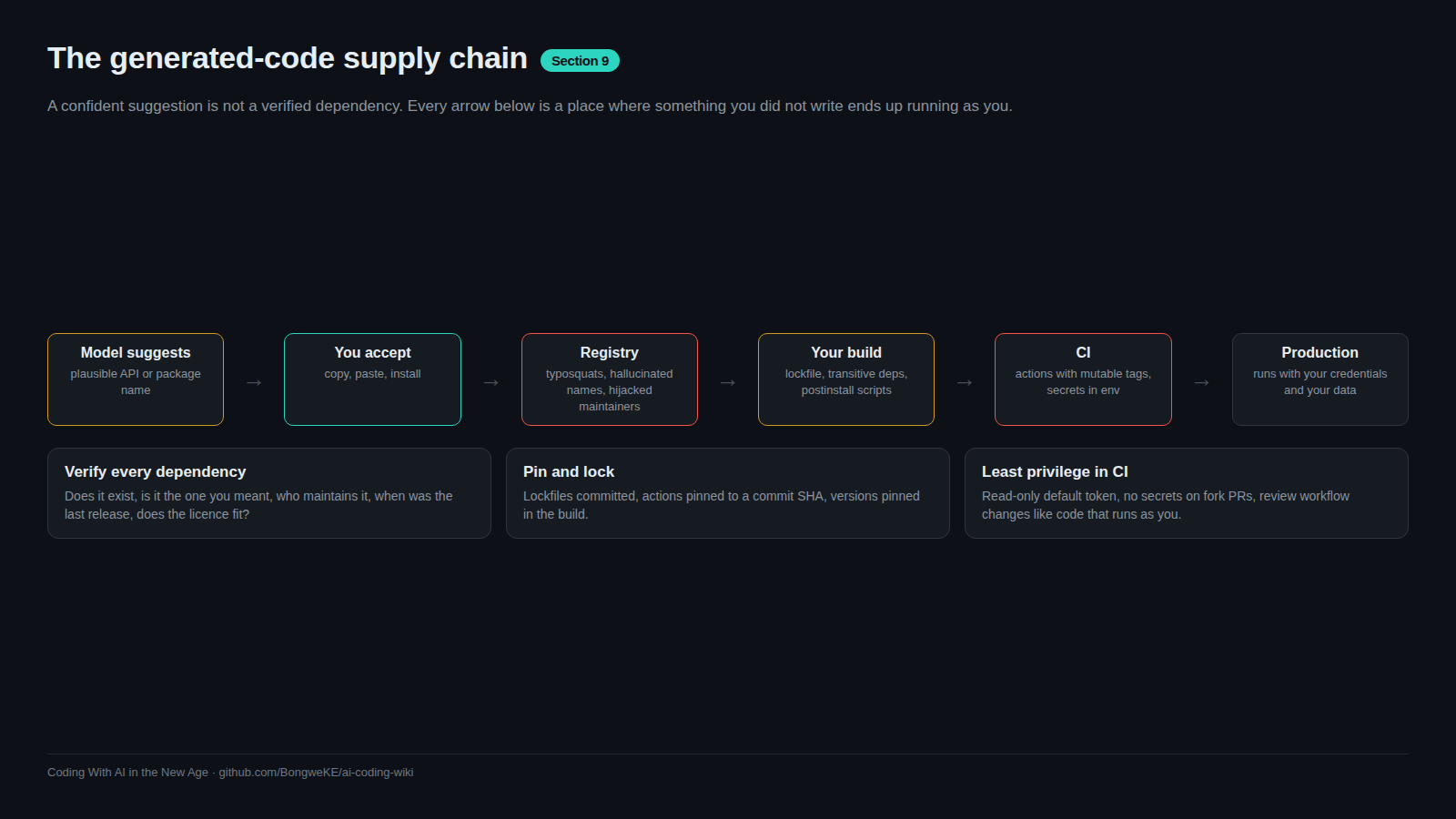
CI/CD as a supply chain
The pipeline holds your deploy credentials, so it is the highest-value thing to compromise.
- Pin third-party actions to a full-length commit SHA. A tag can be moved by anyone who reaches the action's repository; a SHA cannot. As of 2026 GitHub can require this by policy, so a check enforces it instead of your memory.
- Protect the workflow files. Put
.github/workflowsunder code owners so a change needs a named reviewer. Whoever can edit a workflow can run code with your secrets. - Never run untrusted code with secrets. Privileged triggers that check out code from forks run a stranger's commit where your tokens are readable. Keep that in a job with no secrets and no write permission.
- Give the workflow token the least it needs. Default it to read-only repository contents, then raise permissions per job.
- Prefer short-lived credentials. Exchange an identity for a short-lived token rather than storing a long-lived cloud key.
Artefact integrity
Know that what you deployed is what you built.
- Build once, promote the same artefact. Rebuilding between staging and production means production runs a binary nobody tested.
- Publish checksums or signatures with releases and verify them at deploy. This does not stop a compromise, but it makes a swapped artefact loud instead of silent.
- Keep provenance. Record the commit, the run and the inputs that produced the artefact, so "where did this come from?" is a lookup.
- Let only your deploy path write artefacts. Read access for many, write access for the pipeline.
Typosquatting, hallucinated packages and internal names
A model that invents a plausible package name creates an opening for anyone watching the registry. Two checks catch most of it: confirm every new dependency exists, is maintained and is the package the official docs name, and make a human accept every new dependency rather than letting an agent add one mid-task. Your own private names are a target too — if your repo is public and the names are guessable, register placeholders on the public registry first.
The 10-minute monthly routine
Once a month:
- Read every open dependency or update pull request, and merge or close it.
- Clear the vulnerability alerts list.
- Skim the workflows: actions pinned, permissions minimal, secrets referenced by name?
- Confirm the current artefact traces to a commit and a run.
- Delete credentials and variables that no longer have an owner.
Try it
- Confirm you commit a lockfile and that CI installs from it, not from a floating range.
- Enable dependency alerts and automatic update pull requests for the repository.
- Run a local audit on what you have now:
npm audit --omit=dev
pip-audit
- Open
.github/workflows/*.ymland change every third-partyuses:from a tag to a full-length commit SHA, verifying the SHA belongs to the action's own repository. See Hardening GitHub Actions. - Add
.github/workflowsto your code owners file, then run the monthly routine once, on a timer.
Common mistakes
- Pinning an action to a tag and calling it pinned. Tags move. Only a full commit SHA is immutable.
- Letting the updater merge itself. Automatic updates are useful; automatic merges with no test result and no reader are how a compromised release reaches production.
- No lockfile, or a lockfile gitignored. Then your build is a lottery, and a compromise looks like a normal install.
- Rebuilding for production. Two builds, two artefacts, one tested.
- Approving a new dependency because the import resolved. It resolved because something with that name exists. Verify it is the one you meant.
Key takeaways
- Commit your lockfile, pin what you deploy, and keep the dependency count small.
- Automate review: dependency review on PRs, alerts, and update PRs that must pass CI.
- Pin third-party actions to a full-length commit SHA and protect workflow files with code owners.
- Build once, promote that artefact, publish a checksum or attestation, keep provenance.
- Verify every new dependency by hand; a wired-up routine beats good intentions.
Further learning
- GitHub Docs: secure use reference — pinning, token permissions, untrusted checkout and reuse risks.
- GitHub Changelog: SHA pinning policies — enforcing pinning at repository and organisation level.
- OWASP Top 10 for LLM Applications — supply chain risk, including dependencies and model artefacts.
- Trend Micro: slopsquatting — how hallucinated package names get registered and exploited.
- GitHub Actions documentation — workflow syntax, permissions and dependency configuration.