Coding With AI in the New Age
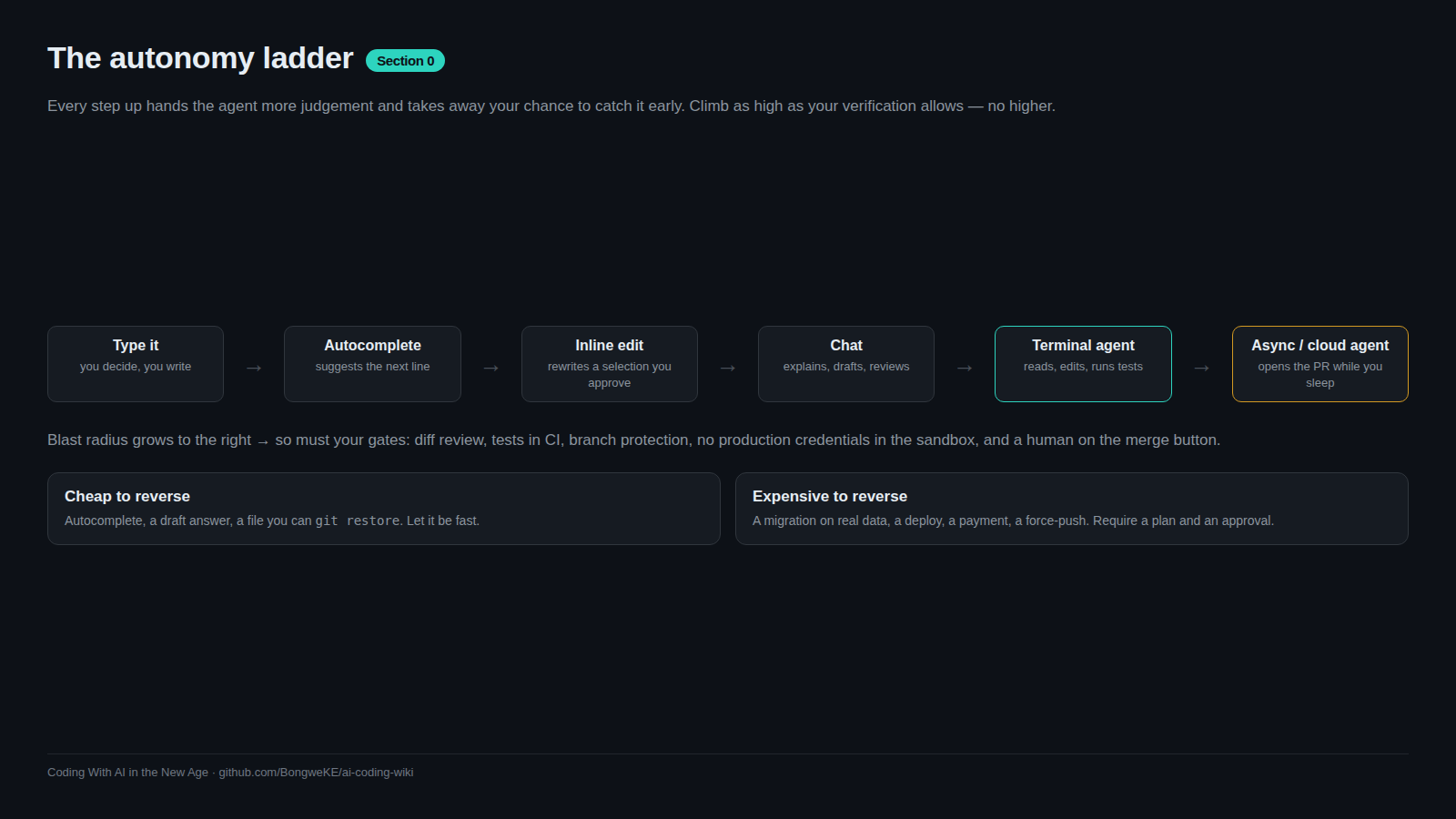
A free, technical, bite-sized wiki for people who are new to software engineering but want to build real things with AI coding agents — and not get burned doing it.
AI wrote a lot of the words here; the lessons came from real projects. Everything is grounded in shipped work, official documentation and public security research. Where a page states a number that changes often, it says so.
Two ways to read this. With full-text search, dark mode and a per-page table of contents: vibe.bongwe.space. On GitHub, for anyone who lands on the wiki tab: this page. Both are built from the same lessons, published from the same source.
Who this is for
| If you are... | Start here |
|---|---|
| Curious, never shipped anything | Set up your workbench → Foundations → Capstone 1 |
| A junior developer using Copilot or chat | Agentic workflows → Checks that matter → Safety & security |
| Building an AI product | Prompting & context → System design → Evals → Costs |
| Leading a small team | Rules of operation → Review of AI code → Case studies |
The journey
Each lesson is 600–1000 words with one exercise, a diagram, the mistakes people actually make, and links to go deeper. Read one, run one command.
| # | Section | What you get |
|---|---|---|
| 0 | Start Here | What AI coding actually is, what the tools are, and a workbench that works. |
| 1 | Foundations | A correct mental model: models, tokens, context, the agent loop, and where agents are weak. |
| 2 | Prompting & Context | Instructions and context an agent can actually execute — including the rules file loaded every session. |
| 3 | Agentic Workflows | The daily craft: plan, implement, test, review, and keep diffs small enough to read. |
| 4 | Agent Skills | Package know-how so any agent gets it right without being re-taught. |
| 5 | Git & CI/CD | Git, the GitHub CLI, workflows, the checks that matter, hardening, releases and deploys. |
| 6 | System Design | Design before code: boundaries, diagrams, state machines, ADRs, schemas, APIs, scale. |
| 7 | Shipping & Deploy | Railway, Neon, edge workers, environments, promotion, rollback and cost control. |
| 8 | MCP | Connect agents to real tools with the Model Context Protocol — and manage the risks that come with it. |
| 9 | Safety & Security | Secrets, generated-code risk, prompt injection, supply chain, OWASP catalogues, privacy, accountability. |
| 10 | Quality | Tests, integration and smoke tests, evals for AI features, definition of done, debugging. |
| 11 | Documentation | Docs as code, READMEs, per-feature docs, lesson banks, runbooks. |
| 12 | Rules Of Operation | SOPs, ADRs, AGENTS.md, skills as operating rules, versioning and change tracking. |
| 13 | Team & Process | Issues, boards, reviewing AI-written code, token economics, ownership. |
| 14 | Case Studies | Four real projects, generalised, with the mistakes that actually happened. |
| 15 | Capstones | Three capstones, a 30-day plan, and where to keep learning afterwards. |
| 16 | Reference | Cheat sheets, templates, the mermaid cookbook and the link index. |
The five rules of this wiki
- Verify with evidence. A green check is not proof anyone read the change.
- Small diffs, small steps. Blast radius scales with diff size.
- Test the deployed artefact, not just your laptop.
- Rules belong in the cheapest layer that works — a rule, a skill, a hook, or a CI gate.
- You own every line you commit, whoever wrote it.
Start here
- How to use this wiki — the learning paths and how to do the exercises properly
- What is AI coding, really? — the vocabulary, ten minutes, no jargon
- Set up your workbench — git, gh, a runtime, an agent, and your first PR
- The 30-day learning plan — if you want a schedule
Extras
- Interactive tools (open them from the repository): prompt anatomy builder, context budget calculator, CI pipeline visualiser, cost calculator.
- Templates: AGENTS.md, ADR, SOP, PR template, CI workflows, SKILL.md.
- Cheat sheets: git, gh, Railway & Neon, mermaid.
- Link index: every source used in this wiki.
Contributing and licence
Issues and pull requests are welcome — see Contributing and the house style in STYLE.md. Text is CC BY 4.0; the scripts and tools are MIT. Nothing here is legal, financial or security advice for your specific system: adapt it, and verify it yourself.