Token And Cost Discipline
Section 03 · Lesson 11 · Level: intermediate · ~12 min · Prereq: Context engineering
Why this matters
Agents cost money per token, and an agentic task spends tokens on things that are invisible in a chat: the context re-sent on every turn, the output of every command, the retries. Most bills are not mysterious. They are a small number of habits repeated a few hundred times.
Where the bill comes from
flowchart TD
    T["One agentic task: the token bill"] --> I["Input tokens: context re-sent every turn"]
    T --> O["Output tokens: replies and generated code"]
    T --> R["Tool results: file reads, command output, logs"]
    T --> P["Retries: failed attempts, loops, re-runs"]
    I --> I1["Grows with session length"]
    R --> R1["Grows with files read and verbose output"]
    P --> P1["Grows with ambiguity and no stop condition"]
The counter-intuitive part is the first box. In a conversational agent, the whole history is re-sent as input on each turn, so a long session pays for its own beginning again and again. Input tokens usually dominate. A measured probe on one production research service found a median cost of about $0.0017 per uncached query (as of 2026) — and, more usefully, that cost tracked the length of the answer and the size of the retrieved context, not how difficult the question looked. Long answers and fat context are the levers. "Hard" is not.
Two pricing facts worth knowing (provider-dependent, as of 2026): cached input tokens can be discounted heavily — on the order of 90% on some providers — and batch APIs can halve the price for work that does not need an instant reply. Check your provider's current numbers; they change.
Cheap habits
- Smaller scope. One feature, one session, one branch. A focused prompt reads three files; a vague one reads thirty.
- Targeted reads. Ask for the function, the file, or the diff — not "read the repo". Just-in-time retrieval beats pre-loading everything.
- Cheaper models for mechanical work. Formatting, renames, small edits, and classification do not need the most capable model. Route the cheap work to a cheap model; reserve the expensive one for design and debugging.
- Caching and reuse. Where a provider offers prompt caching and the work repeats a stable prefix, use it. Where a result repeats, cache the result — a cache hit that avoids a model call costs nothing.
- End sessions. A fresh session with a short hand-off note is almost always cheaper than a bloated one. See agent memory and session hygiene.
- Stop conditions. "Stop after three attempts and report" prevents the expensive failure mode: an agent looping on the same error until your budget is gone.
Measure, do not guess
Guessing at cost produces two bad outcomes: you under-provision and get surprised, or you over-provision and pay for headroom you never used. Measure:
- Usage dashboards. Every provider exposes token and spend views. Read them weekly, not once.
- A cost probe per feature. Pick one representative task and record tokens in, tokens out, and cost. Repeat after a change. This is how you learn that answer length — not query difficulty — drives your bill.
- A budget with a kill switch. A spend limit that stops the work, not a dashboard that reports it after. Set it before you scale up, not after the first surprise invoice.
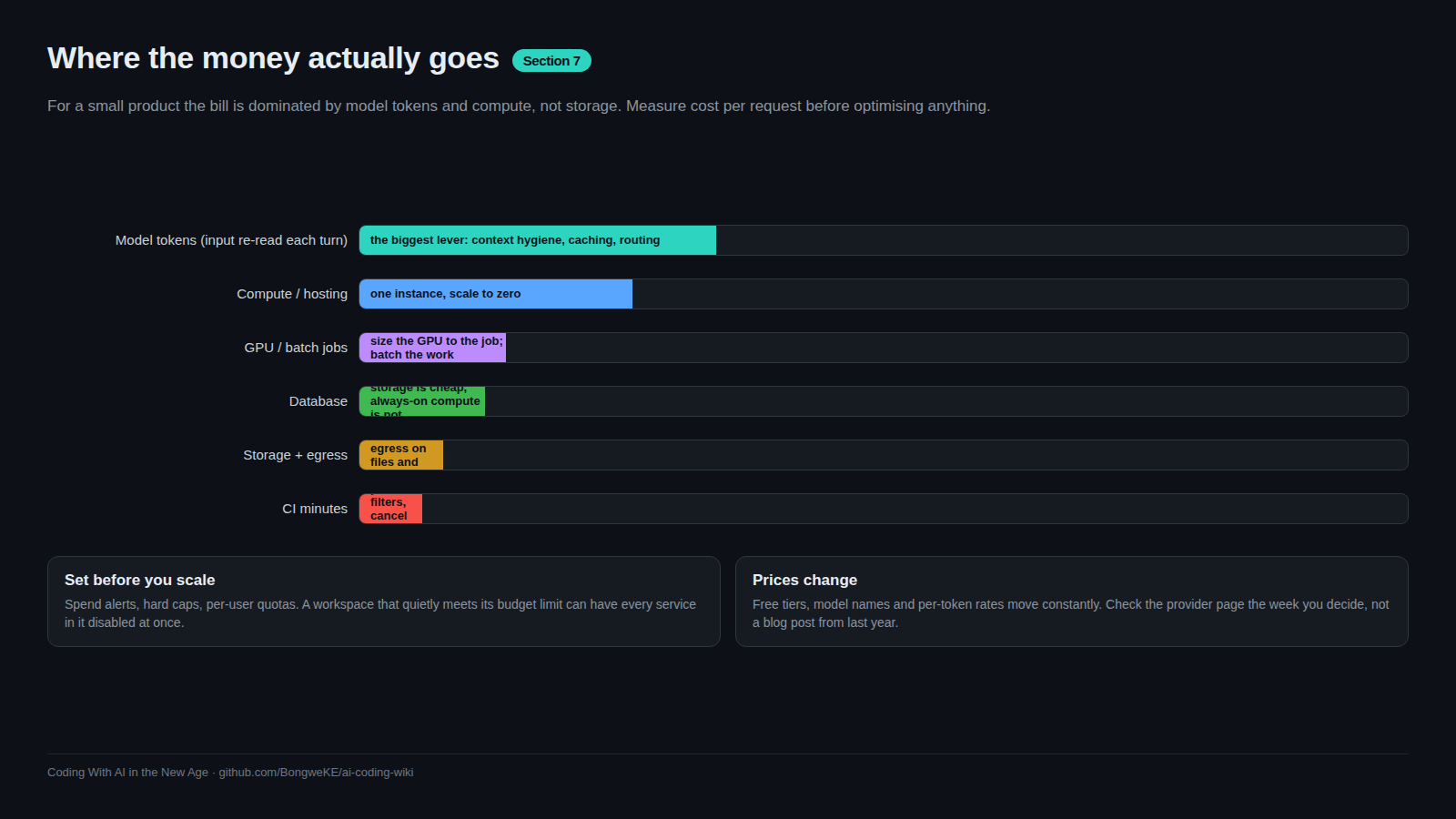
The tiering above is the point: most infrastructure cost tends to be flat monthly fees, and the usage-driven part is what moves when behaviour changes. Knowing which is which tells you where to optimise.
The organisational lesson
A runaway agent in a retry loop can burn real money in a short window. It usually looks like this: a failing command, a fix that does not work, another attempt, and no ceiling. The loop is honest — the agent is trying — and expensive.
Guard against it before you scale:
- A per-task and per-day spend limit, enforced by the platform, not by intention.
- A retry cap in the prompt: three attempts, then report and stop.
- One person responsible for reading the bill. Shared responsibility means nobody looks.
Token cost is a design constraint, not an accounting afterthought. The same habit that keeps a session small — narrow scope, read what you need, stop when you are done — is also the habit that keeps the bill small.
Try it
- Run one small task and record tokens in, tokens out, and cost from your provider's dashboard.
- Run the same task with a tighter prompt (named files, no exploration) and compare.
- Pick a mechanical task (a rename, a format pass) and run it on a cheaper model. Compare quality and cost.
- Set a spend limit on your account today, at a number that would annoy rather than bankrupt you.
- Add "stop after three attempts and report what failed" to your rules file.
- End every session at a natural boundary with a hand-off note; note the token drop.
Common mistakes
- One week-long session — input tokens re-sent every turn dwarf everything else. End sessions.
- "Read the whole repo and fix it" — the exploration alone can cost more than the fix. Point at files.
- The top model for everything — formatting and renames do not need it. Route by task.
- No spend limit — the retry loop has no natural ceiling. Set the kill switch first.
- Measuring once — pricing and models change, and so does your code. Re-probe after significant changes.
- Counting only output — the visible reply feels like "the cost" while the invisible input dominates. Read both numbers.
Key takeaways
- Input tokens dominate; the history is re-sent every turn.
- Cost tracks answer length and context size, not perceived difficulty.
- Smaller scope, targeted reads, cheaper models for mechanical work, and caching are the cheap wins.
- Use dashboards and per-feature probes; do not estimate.
- Set a spend limit and a retry cap before you scale up.
- Ending a session is a cost-control technique, not just a hygiene one.
Further learning
- Effective context engineering for AI agents — why context is a finite resource and how to spend it well.
- OWASP Top 10 for LLM applications — excessive agency, including the unbounded-action failure behind runaway cost.
- Context engineering — the upstream practice that makes most of these habits automatic.