OWASP LLM Top 10 In Plain English
Section 09 · Lesson 6 · Level: intermediate · ~20 min · Prereq: Prompt injection and exfiltration
Why this matters
The OWASP LLM Top 10 is the shared vocabulary for "what goes wrong when you put a model inside a product". If you build an AI feature, it is your review checklist. If you use a coding agent, it describes half your own working day. Knowing the names means you can search for the fix instead of rediscovering the bug.
What the list actually is
The list is published by the OWASP GenAI Security Project, which also maintains agentic-AI guidance and cheat sheets. It is versioned and evolving: the 2025 edition is widely cited, and the project has since published a 2026 edition. Item numbers move between editions, so check the project's list page before citing a number, and link the project rather than a blog summary. Below, each risk is named, not numbered by guesswork.
The ten, one at a time
Prompt injection — untrusted text is read as instructions instead of data. Ordinary example: a support ticket containing "ignore previous instructions" gets summarised by your assistant, which then does what the ticket said. Cheapest mitigation: clearly separate system instructions from data, and treat everything fetched from outside your code as hostile.
Sensitive information disclosure — the model is fed, or leaks, data it should not hold. Ordinary example: an upstream payment response logged in full and pasted into a prompt that says "summarise this failure". Cheapest mitigation: redact before logging and before prompting.
Supply chain — you trust a component you never read. Ordinary example: a pinned-by-tag CI action, or a package name the agent invented, which someone else has registered. Cheapest mitigation: pin actions to full-length commit SHAs, and verify a package exists on its registry before installing.
Data and model poisoning — the material the model learns from or retrieves is corrupted. Ordinary example: someone adds a document to your knowledge base that says failures are impossible, and retrieval starts returning it. Cheapest mitigation: an allowlist for what may be written into retrieval stores and memory, with human review of additions.
Improper output handling — model output is used as if it were trusted input. Ordinary example: generated SQL is executed directly, or generated HTML is rendered unescaped. Cheapest mitigation: validate output against a schema and never eval it.
Excessive agency — the system can do more than the task needs. Ordinary example: a "fix the failing test" agent with a token that can also force-push to main. Cheapest mitigation: read-only by default, explicit approval for destructive actions, and permissions enforced in the backend rather than in the prompt.
System prompt leakage — your instructions become readable. Ordinary example: the system prompt contains an internal endpoint or a customer name, and a user asks the model to repeat its instructions. Cheapest mitigation: never put anything in a system prompt that you could not publish.
Vector and embedding weaknesses — retrieval returns content the caller should not see, or poisoned content ranks highly. Ordinary example: one tenant's document surfaces in another tenant's answer. Cheapest mitigation: filter by tenant and permission at query time, not after generation.
Misinformation — confident output that is simply wrong. Ordinary example: a generated summary that reverses the policy it summarises. Cheapest mitigation: require citations to the source and verify any claim a human will act on.
Unbounded consumption — cost and load grow without limit. Ordinary example: an agent loop that retries an impossible task until your provider bill notices. Cheapest mitigation: per-run budget and step caps, timeouts, and per-identity rate limits.
flowchart TD
    R["Ten risks, five root causes"] --> A["Input trust"]
    R --> B["Output trust"]
    R --> C["Dependency trust"]
    R --> D["Autonomy"]
    R --> E["Resource use"]
    A --> A1["Prompt injection"]
    A --> A2["Data and model poisoning"]
    B --> B1["Improper output handling"]
    B --> B2["Sensitive information disclosure"]
    B --> B3["Misinformation"]
    C --> C1["Supply chain"]
    C --> C2["Vector and embedding weaknesses"]
    D --> D1["Excessive agency"]
    D --> D2["System prompt leakage"]
    E --> E1["Unbounded consumption"]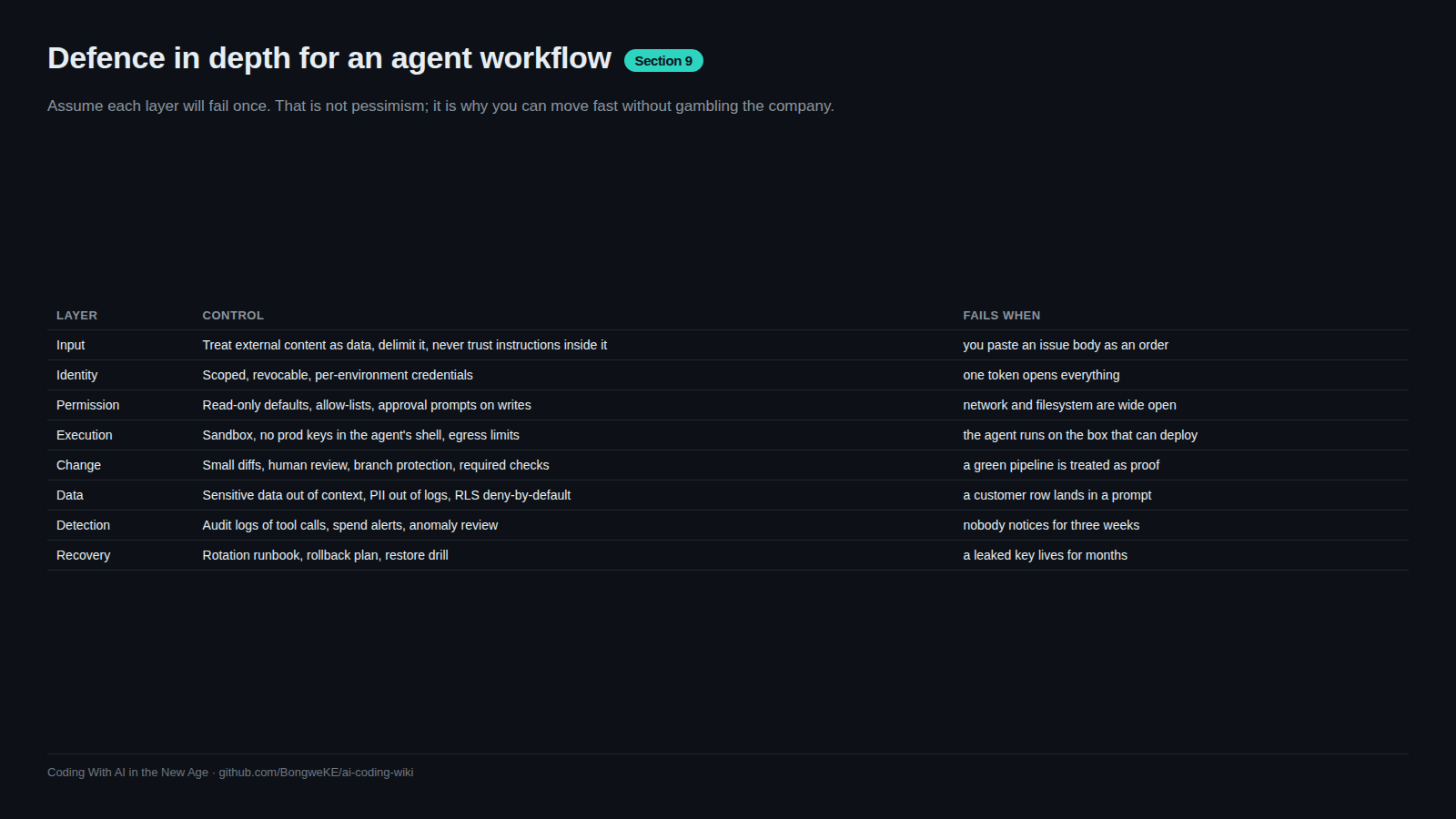
You are both the builder and the target
As a builder, every item applies to the product you are shipping. As an agent user, the same items describe your own workflow: your context is filled from issue text, code comments and tool output (injection); your skills, MCP servers and CI actions are dependencies (supply chain); your agent holds a shell and a token (excessive agency); a runaway loop spends real money (unbounded consumption); and a wrong lesson written into a rules file outlives the session that wrote it.
Using it as a pre-ship review
Do not turn the ten into a compliance badge. Walk them once per feature, with three columns: applies, cheapest control, owner. Anything marked "does not apply" needs one sentence of justification, because a reviewer will challenge it.
Try it
- Write the ten risk names on one page, in your own words.
- For your current project, mark each one applies or does-not-apply, with one clause of justification.
- For each "applies", write the cheapest control you already have. If there is none, that line is your backlog — put it in an issue today.
- Paste the list into your agent and ask: "For each risk, name where untrusted input reaches the model, and say when you are unsure." Then verify its claims yourself.
Common mistakes
- Treating the list as a certification. It is a review aid, not a standard you "pass". The project states the content is provided without warranty.
- Citing item numbers from a stale summary. Editions change and numbering shifts; link the project's list page instead of quoting LLM0x from a blog post.
- Filtering only user input. Dangerous injections usually arrive in content the agent reads: an issue body, a README, a tool response, a fetched page.
- Putting secrets in the system prompt and calling it private. If the model can see it, the model can be asked to repeat it.
- Granting a broad token "because it is only staging". Staging credentials are often copied into production config.
Key takeaways
- Learn the ten names; they are how you search for the fix.
- Every risk has a cheapest control, and the cheap controls cover most of the exposure.
- Untrusted content your agent reads is the injection surface, not just the user's message.
- The list is versioned — link the source of truth before citing it.
Further learning
- OWASP GenAI Security Project — LLM Top 10 — the current list, archives and per-risk pages.
- OWASP Top 10 for LLM Applications (project page) — the OWASP project entry point.
- LLM Prompt Injection Prevention Cheat Sheet — concrete input, output and action defences.